Tuesday, February 02, 2010

Screenplay Review: The Master


The following review for a screenplay called "Untitled PT Anderson Scientology" was posted by someone's blog titled "The Cinematic Experience Of Forizzer" and made aware to the world via The Playlist.

The following will most certainly contain specifics. If you do not wish to have the film spoiled for you in anyway, please do not highlight the text pasted below:

Heyo, I’m back. Computer is fixed and I’ve quite a few things to review (The Last Station and some classics I caught over the past week+). I’ve also gotten into the habit of reading scripts and fortunately for me, I have connections and was able to read the Untitled Scientology script by Paul Thomas Anderson. One of the few in the world, I believe, so I’m quite content with myself.
PLOT SYNOPSIS: Freddie, a young man in his mid-20s, has his appendix burst. Not very much a man too concerned for family, he found his calling in the Navy. With a burst appendix, he can no longer handle the rigorous tasks the Navy calls upon their men. Isolated and looking for his calling, Freddie becomes an alcoholic at the snap of finger; so much so that he brews his own ale — an ale so strong that, when in southern US, a poor immigrant worker drinks ‘an unbalanced quantity’, goes into convulsions and is assumed to have died while Freddie scampers away from the site.
Afraid of being caught, Freddie hops aboard the first vessel he spots. Half drunk out of his mind, half worried for his life and half looking for work, this type of calculation indicates the mess that is Freddie. Aboard the ship, a man that goes by Master (the role Philip Seymour Hoffman is set to portray) begins to guide Freddie. He asks him odd questions and tries to rid the young man of his dependencies. Master is an allegorical L. Ron Hubbard, for the curious.
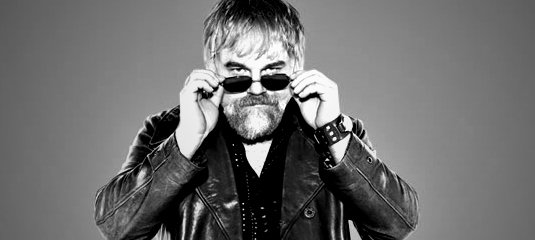
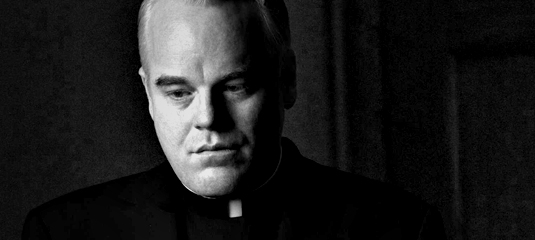
Master has a family — a wife and four children (three daughters, one about to get married, and a son) — and a group of followers that adhere to everything he says. He’s also skeptical of strangers, which allows for quite a frantic… but usually composed character. It will be vastly interesting to see what Philip Seymour Hoffman does with the role — it’s his most varied and unique to date.
OVERALL IMPRESSION: The script was mashed together rather haphazardly. There’s plentiful segments that say “Insert Dialogue at a Later Date” or varients of that. The composition of it all is rather amateur as well. If one were to pick this script up, they’d assume this person had no script writing program or spell check (there are a fair share of spelling errors). 
The story itself is very peculiar. There’s sexual perversion in parts, extreme moments of eccentricity from Master, lots of interesting theories about life and the purpose of it, and even some humor slighting Scientology. If one expects this story to completely laugh at Scientology, think again. It’s more demonstrative of loneliness and why someone would find solace in the least likely of religions as opposed to a flagrant foul against the belief. It’s partially jumbled in what it means to preach, script-wise, but I believe that this will all find further clarity with a the script revisions that follows and the inevitable direction of the feature.
For the lead role of Freddie, I imagined a Paul Dano type. Perhaps a little bit bulkier as one would imagine a slightly bloated gut to accompany alcoholism and a burst appendix. Someone mostly scrawny and who can play off drunkenness well will do favorably in this part. Hoffman as Master is a wicked choice — expect a second Oscar win for what he puts himself through. The rest of the cast is rather plain… it’s like a The Last King of Scotland in that sense: two major characters and everyone else just, well, there.
It reads at 124 pages. If you go the traditional minute per page, you get just over two hours. Of course, I think that’s too simply a strategy, so I go by what I feel it is. The first 10-15 pages are heavily descriptive, so I imagined them slightly longer. I figure this will be about 135 minutes long without credits. So perhaps 140 minutes overall.
FINAL WORD: Poorly written, but excellently constructed, Untitled Scientology is one of the better scripts I’ve ever read (not too big a feat, but…). In addition, it has an ending that will keep you thinking — I know it has for me, and I read it two days ago. So I suppose I’ll toss this script an 8/10. PTA’s assembling of it all might raise it to a 9 when all is said and done. Yeah, it’s good. And no, you may not have the script. 

Friday, December 18, 2009

Best Film Of The Decade: There Will Be Blood


The Gawker website has taken it upon themselves to tally up countless reviewers Top Films Of The Decade lists that have been spreading everywhere to see which film overall was the highest ranked. With 12 votes, There Will Be Blood won top honors. They said:

In its day, Paul Thomas Anderson's oil-drilling epic had to take a back seat to the Coen Brother's nihilist No Country For Old Men. But a few years later, this Blood will not be washed out.
The web has come alive with Best Film of the Decade lists. Unlike Best of the Year lists, where the same dozen or so films appear again and again, Best of the Decades are where a list-making critic can really take wings and fly, revealing their inner soul through their choices. Are you a Lost in Translation type or a Memento -ite? The choice says everything, and nothing, about the list makers.
So what we've done is added up all the Best lists we could find online — from the New Yorker to spitefulcritic.com; anywhere where people had made a list. We gave each film a point for every inclusion on every top ten list. Some lists made it a bit difficult, doing say an unordered top 15's, but we've included as much as we can to try and get an accurate count.
Also in the case of multi-film series, such as Lord of the Rings or the Bourne films, some critics placed the entire series on the list, some cast their votes for the individual films.
And when the votes were all in, by a nose, There Will Be Blood stood alone at the top of the decade, its straw in the whole damn cinema's milkshake.
View their entire list of films by clicking here.

Tuesday, December 08, 2009

"Don't Know Much About The Master," Hoffman


Despite the post's subject, I had to find some other keyword to mix up the banners a little. Last night, someone from New York Magazine caught up with Phil Hoffman at LAByrinth and fished around for further details regarding "The Master." Unfortunately, it didn't really work:

In keeping with our ongoing crusade to bring you all the latest info, pertinent or otherwise, on Paul Thomas Anderson's upcoming Philip Seymour Hoffman–starring The Master, which may or may not be about the birth Scientology, we asked Hoffman about it at last night's last night's Celebrity Charades benefit for LAByrinth Theater Company. "I really don't know much about it. If [you] know anything, [you] know more than I do," he told us, explaining that he's not yet seen a script. Is it about Scientology? we asked. To which he replied: "No idea." 

Thursday, December 03, 2009

New York Magazine Talks 'The Master'


In an article titled "So This New Paul Thomas Anderson Movie Is Definitely About Scientology, Right?," New York Magazine had this to say about his forthcoming sixth feature currently being called "The Master."

Announced last night and already pretty much the upcoming movie we're most looking forward to, Paul Thomas Anderson's The Master will star Philip Seymour Hoffman in the title role as a charismatic dude who founds his own religion in 1952. The film's primary action will allegedly revolve around the clash between Hoffman's character and his second-in-command, a twentysomething guy named Freddie who comes to question what his boss is selling. So, even though Scientology's Wikipedia entry makes no mention of any troublemakers named Freddie, can we safely assume that the film will be a thinly veiled, Bowfinger-y slap at L. Ron Hubbard?
We're certainly going to! Despite Hoffman's physical resemblance to Hubbard and that Scientology was also founded in 1952, Variety claims "the drama does not so much scrutinize self-started churches like Scientology or the Mormons, as much as it explores the need to believe in a higher power, the choice of which one to embrace and the point at which a belief system graduates into a religion." But presumably they'd have to say something like that to get this thing made in Scientology-controlled Hollywood (Universal is apparently waiting on a final draft of the screenplay before it okays the film's $35 million budget).
We wonder if, to any degree, the idea for Master was inspired by Anderson's friendship with Jeremy Blake, the visual artist with whom he collaborated on 2002's Punch Drunk Love. As you'll recall, Blake and girlfriend Theresa Duncan took their own lives in 2007 under mysterious circumstances, with Duncan alleging they'd been harassed by Scientologists after the couple's friend Beck told them he was thinking about leaving the religion (Beck, of course, denied this). So we guess we probably shouldn't look for "Devil's Haircut" on The Master's soundtrack.
You can check out the same information but arranged a little different on their website by clicking here.

Wednesday, December 02, 2009

Details On New Paul Thomas Anderson Feature!


Variety is reporting the following about the sixth as-of-yet Untitled follow-up feature to There Will Be Blood written and directed by Paul. Here's their update:

“There Will Be Blood” writer/director Paul Thomas Anderson has found religion, and Philip Seymour Hoffman, for his next film. 
Anderson has written an untitled period drama that is set up at Universal. Hoffman, who has played supporting roles in most of Anderson’s past films, would this time be the centerpiece. 
Hoffman will play “The Master,” as in “master of ceremonies,” a charismatic intellectual who hatches a faith-based organization that begins to catch on in America in 1952. 
The core is the relationship between The Master and Freddie, a twenty-something drifter who becomes the leader’s lieutenant. As the faith begins to gain a fervent following, Freddie finds himself questioning the belief system he has embraced, and his mentor. 
Anderson's treatment of religion was cynical in "There Will Be Blood." Here, the scrutiny isn't specifically directed toward faith-based movements like Scientology or Mormonism that are newcomers compared to established religions. Anderson explores the need to believe in a higher power, the choice of which to embrace, and the point at which a belief system graduates into a religion. .  
Universal, which has become very selective about green lighting adult dramas, won’t make a decision on Anderson’s $35 million budget pic until he delivers his finished script. His hope is to make the picture next year, sources said. 
Anderson’s frequent collaborator, JoAnne Sellar, is the producer.  
Hoffman made his breakthrough in the cast of Anderson’s “Boogie Nights,” and has also appeared in the Anderson-directed “Hard Eight,” “Punch-Drunk Love” and “Magnolia.” 
Neither the studio nor reps for Anderson or Hoffman would comment. 

Monday, September 01, 2008

Anderson Wins 2nd Fipresci Award For TWBB

Variety reports that Paul Thomas Anderson will be on hand to receive The Grand Prix Film Of The Year award at the San Sebastian Film Festival.

Paul Thomas Anderson’s searing portrait of overweening ambition, “There Will Be Blood,” has won the Fipresci (the Intl. Federation of Film Critics) Grand Prix for film of the year. 
Anderson will pick up the prize in person at the opening ceremony of San Sebastian Festival on Sept. 18.
The latest kudos comes after “Blood” took director at Berlin and Academy Awards for Daniel Day Lewis for lead actor and Robert Elswit for cinematography.
The plaudit from the world’s foremost film critics’ org consolidates Anderson’s position as one of the most critically admired directors out.
Fipresci noted Monday that Anderson had been a clear winner among the 242 critics who voted this year for the Grand Prix.
Anderson already won a Fipresci Grand Prix in 2000 for “Magnolia.” 
Other recent winners, pointing to top niches in a modern critics’ pantheon, are Nuri Ceylan Bilge’s “Uzak,” Jean-Luc Godard’s “Notre musique,” Kim Ki-duk’s “3-Iron,” Pedro Almodovar’s “Volver” and, last year, Cristian Mungiu’s “4 Months, 3 Weeks & 2 Days.”

Tuesday, March 04, 2008

Inteview: Museum of the Moving Image

Museum of the Moving Image, Queens NY
December 2007

Listen to the talk here.


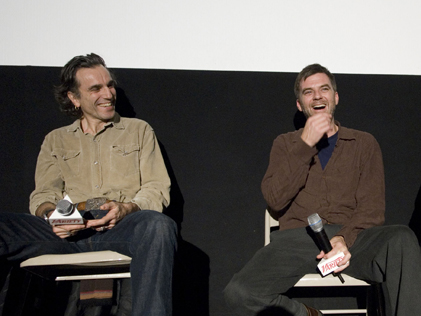
A PINEWOOD DIALOGUE WITH DANIEL DAY-LEWIS AND PAUL THOMAS ANDERSON

Daniel Day-Lewis’s magnificent performance as the ambitious and ruthless oil tycoon Daniel Plainview is at the core of Paul Thomas Anderson’s critically acclaimed movie There Will be Blood. In this discussion, which followed a Museum of the Moving Image preview screening of the film, the actor and director playfully and thoughtfully discussed their intense collaborative process.

Saturday, March 01, 2008

The Dirk Diggler Story (1988)


A 31 minute short film shot by Paul when he was just seventeen years old. It was written and shot like a Spinal Tap documentary about the rise and fall of Dirk Diggler.  It was shot on video and edited VCR to VCR. His dad narrated it (like an E! Hollywood true story). Mike Stein (a good friend who also had a small role in Boogie Nights) played Dirk Diggler. Bob Ridgely (The Colonel) played Jack Horner. The length was about 30 minutes. Rewritten as a full length movie when he was about 19-20 in the same vein but decided that the "Spinal Tap" thing was played out.

Saturday, January 05, 2008

Interview: The Guardian UK


The Guardian UK, Written By Ed Pilkington
January 2008

'Tell the story! Tell the story!'
With his "big oil epic" starring Daniel Day Lewis, Paul Thomas Anderson is no longer American cinema's enfant terrible. All he wants to do now is spin a good yarn, he tells Ed Pilkington


It is 10 years since Paul Thomas Anderson first left audiences and critics dumbstruck and confounded with his breakthrough film Boogie Nights, when he was just 27. How could such a pipsqueak of a director, they asked back in 1997, create a masterpiece that wowed right from its opening sequence: an audacious five-minute tracking shot that swoops and swirls through the nightclub of the film's title in joyful synchronisation to the dance music of the 1970s.

He has astonished ever since. Magnolia, the next out of the blocks, was an even bigger, more complex and yet richly evocative film that belied any attempt to categorise it. He was 31 by then, but still people marvelled at how one so young could conjure up such accomplished work. Anderson appeared to have found his style - the repertory film in which a multitude of characters and plot-lines are interwoven. But then in 2002 he bamboozled us again. He threw out the repertory technique and opted instead for a radically scaled-down and linear story in Punch-Drunk Love. It ran at a conventional 90 minutes - half the length of Magnolia - and though the film was anything but conventional, it left many fans delighted, others disappointed.